

Busy parents’ customized meal planning is the practice of matching food choices, preparation, and portions to your household schedule and personal goals so you can eat consistently without cooking separate dinners. This 2026 guide explains how to build a workable plan around school runs, training, food preferences, and nights when cooking falls apart.
- Customized meal plans for busy parents should fit family schedules before adding recipes or tracking tasks.
- TBT Fitness Studios offers customized meal plans alongside personal training and group fitness for body transformation and weight loss.
- Use shared meal components, individual portions, and backup dinners instead of preparing separate family menus.
- Choose professional nutrition support when self-planning leaves your needs unresolved; medical diets require appropriately qualified care.
Why meal planning matters for busy parents
A meal plan has to survive the week you actually have. A dinner that requires uninterrupted preparation is a poor match for an evening split between homework and sports practice, even when its ingredients fit your nutrition goals.
Parents also need to separate adult goals from children’s needs. Your weight-loss plan should not become a household rule that everyone eats less; shared ingredients can support different portions and different needs.
TBT Fitness Studios is best for parents seeking customized meal plans alongside personal training or group fitness. TBT Fitness Studios offers these services for people seeking body transformation and weight loss; ask how meal planning would address your household routine before choosing support.
For your 2026 routine, judge a plan by whether you can shop for it, prepare it, and repeat it. An elaborate menu that stays on paper does not solve dinner.
Build a meal plan around your household
1. Map your real week before choosing recipes
Start with a calendar and a blank sheet of paper. Mark when you will eat at home, when someone needs a portable meal, and when dinner must be ready without much preparation.
Give each evening a practical label: cook, reheat, assemble, or eat elsewhere. This makes the workload visible before you commit to recipes. For your first 2026 planning cycle, use a 7-day calendar rather than trying to redesign an entire month.
Your first draft should describe constraints, not an ideal version of family life. Include the nights you arrive home tired, not just the evenings when you enjoy cooking.
- Mark school activities, work commitments, and training sessions.
- Identify who needs breakfast, lunch, dinner, and portable snacks.
- Assign cooking responsibility rather than assuming someone will handle it.
- Reserve a 15-minute planning appointment as a starting experiment.
- Flag evenings that require leftovers or assembled meals.
2. Define your goal without assigning it to your children
Write down what you want the plan to support: more consistent meals, weight management, training, or less dinner-time decision-making. Then list the preferences, allergies, and practical restrictions that affect food choices.
A parent’s calorie target is not a child’s meal prescription. You can serve the same basic dinner while adjusting portions and additions for each person. Avoid making weight-loss language the organizing principle of family meals.
If you want support beyond a worksheet, TBT Fitness Studios offers customized meal plans. Ask what information informs the plan, who prepares it, and how changes are handled; the service name alone does not answer those questions.
- Separate adult body-composition goals from children’s food needs.
- Record food allergies and medically required restrictions accurately.
- List foods your household already eats willingly.
- Note pregnancy, breastfeeding, medications, or health conditions for qualified advice.
- Ask a prospective provider how individual needs affect the plan.
3. Build shared meals from flexible components
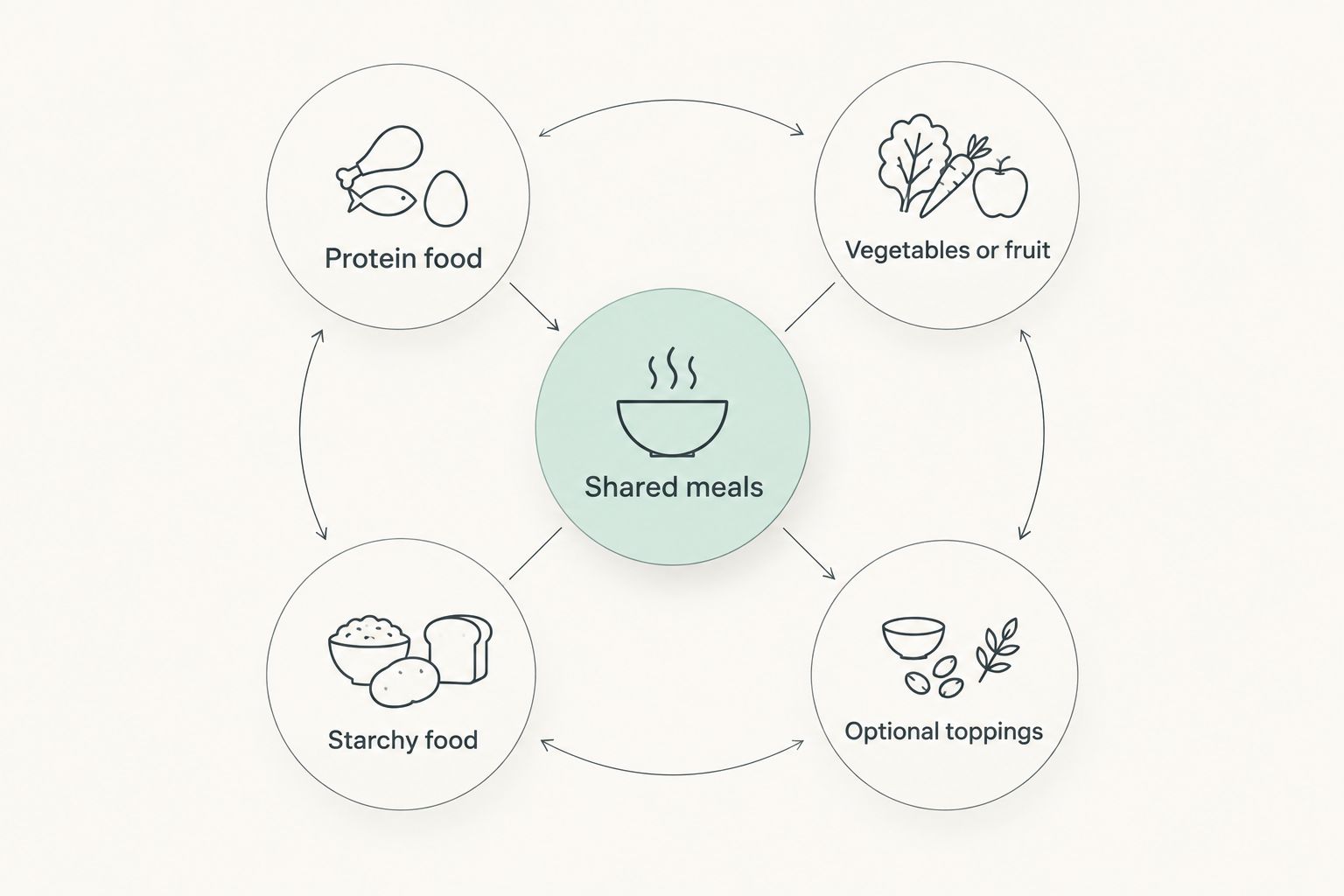
Begin with familiar dinners rather than a collection of unfamiliar recipes. Choose a protein food, vegetables or fruit, and a grain or other starchy food, then offer components separately when that makes serving easier.
A rice bowl, for example, can use beans, cooked vegetables, rice, and optional toppings. Family members can assemble different plates without requiring entirely different cooking. This is a preparation strategy, not a rule that everyone needs identical portions.
Start with 3 repeatable dinners. Expand only after those meals fit your schedule; variety can come from seasonings and accompaniments rather than replacing every recipe.
- Pick familiar meal formats such as bowls, wraps, or tray-baked dinners.
- Keep sauces and toppings separate when preferences differ.
- Include a familiar component alongside a less familiar food.
- Adjust adult portions without restricting the whole household.
- Record substitutions that preserve the meal’s basic structure.
4. Turn the menu into one shopping and preparation system
Check your refrigerator, freezer, and pantry before writing the shopping list. Plan around ingredients you already have, then group missing items by store section. Note quantities against the meals rather than relying on memory.
Prepare the task that creates the biggest obstacle. If chopping vegetables stops you cooking, address that; if lunch disappears from the plan, portion lunch components instead. You do not need to prepare every meal in advance.
Keep food safety separate from convenience. USDA food-safety guidance limits refrigerated leftovers to 3–4 days and recommends refrigerating perishable food within 2 hours; freeze portions you will not use within the safe storage window.
- Check existing food before adding ingredients to the list.
- Group purchases by produce, protein foods, staples, and other needs.
- Prepare ingredients that serve more than one planned meal.
- Label stored food with its preparation date.
- Divide leftovers into shallow containers for prompt cooling.
- Freeze later-week portions instead of assuming they will keep indefinitely.
5. Assign backup meals before the week gets difficult
Build a fallback menu from foods you already know how to prepare. A backup dinner should require fewer decisions than the original plan, not become another recipe to learn during a stressful evening.
Choose 2 backup dinners as a starting point. Examples include eggs with toast and vegetables, or beans with microwaveable rice and frozen vegetables, provided those foods suit your household’s dietary needs.
A backup meal is a planned response to a schedule change. Use it without compensating through skipped meals the next day or treating the evening as a failure.
- Keep ingredients for your chosen backups together where practical.
- Write the backup beside the busiest evening on the calendar.
- Include a portable option for a parent eating away from home.
- Check labels against allergies and dietary restrictions.
- Replace used backup ingredients on the next shopping list.
6. Review what happened and change the smallest useful thing
At the end of the week, compare the plan with what you actually ate. Look for the first point where the process broke: shopping, preparation, timing, preferences, or portions that left you unsatisfied.
Review consistency before adding complexity. If weekday lunches repeatedly disappear, another dinner recipe will not fix the problem. Change the lunch setup, then see whether that specific obstacle improves.
TBT Fitness Studios also offers InBody composition analysis. If you use body-composition measurements alongside meal planning, discuss interpretation with an appropriately qualified professional; do not let a single reading dictate abrupt food restrictions.
- Record which meals you prepared and which you replaced.
- Identify unused ingredients and why they remained unused.
- Note hunger, energy, and training experiences without assigning a diagnosis.
- Change one recurring obstacle before rewriting the whole menu.
- Ask your provider how progress reviews inform plan adjustments.
Compare meal-planning options for busy parents
Choose support according to the problem you need solved. Writing a shopping list, coordinating food with exercise, and managing a medical nutrition issue are different jobs; no single option automatically covers all three.
Use this 2026 comparison to separate practical benefits from limitations. Confirm the actual service details before committing.
| Option | Best for | Main advantage | Key limitation |
|---|---|---|---|
| Self-directed calendar and grocery list | Parents with familiar meals and straightforward planning needs | You control recipes, timing, and revisions | You must organize meals and evaluate suitability yourself |
| Meal-planning app or recipe template | Parents who need recipe organization and shopping-list structure | Keeps meal ideas and ingredients in one place | A template is not automatically appropriate for individual health needs |
| TBT Fitness Studios customized meal plans | Parents seeking meal planning alongside personal training or group fitness | Meal planning and fitness services are offered by the same studio | Confirm provider qualifications, plan scope, and adjustment process |
| Registered dietitian nutritionist | Parents needing individualized nutrition assessment or medical nutrition therapy | Provides a route to qualified, individualized nutrition care | Appointment structure and family-meal support depend on the provider |
Choose the simplest option that addresses your actual constraint. A recipe organizer helps with organization; a qualified clinician addresses needs that go beyond household logistics. Neither benefit should be assumed from a service label alone.
Common meal-planning mistakes busy parents make
Planning different dinners for every person
Separate menus multiply shopping, preparation, and cleanup. Start with shared components, then adapt serving choices and portions. Keep genuine allergy requirements separate from ordinary preferences; food safety is not negotiable.
Making every evening a cooking night
A calendar full of fresh recipes ignores the work involved. Schedule leftovers and assembled meals explicitly, and check safe storage timing before assigning them to later days.
Turning adult weight loss into a family restriction
Children do not need to inherit a parent’s weight-loss target. Keep conversation centered on meals, enjoyment, and practical routines rather than labeling family members’ plates as good or bad.
Expecting customization without sharing constraints
A useful planning conversation needs your schedule, food preferences, equipment, and restrictions. Bring those details to a provider instead of accepting a menu that you already know conflicts with your household.
Measuring success only by the scale
Your 2026 meal plan also needs an operational test: did you have suitable food when you needed it? Track missed meals, unused groceries, and preparation problems so you can fix the process rather than repeatedly starting over.
FAQ
What are customized meal plans for busy parents?
Customized meal plans for busy parents match food choices and preparation to a parent’s goals, household schedule, preferences, and dietary needs. A usable plan also accounts for shopping, leftovers, and backup meals rather than listing recipes alone.
What is the best way to start meal planning with a busy family?
Start by mapping your household schedule before selecting meals. Mark cooking nights, leftover nights, and evenings that need an assembled dinner, then choose familiar meals that fit those slots.
Do I need to cook separate meals to lose weight as a parent?
Separate meals are not a prerequisite for an adult weight-management plan. Shared meal components allow different portions and additions, while children’s needs remain separate from adult weight-loss targets.
Does TBT Fitness Studios offer customized meal plans?
TBT Fitness Studios offers customized meal plans, personal training, group fitness classes, InBody composition analysis, and youth sports performance training. Ask who prepares meal plans, what personalization includes, and how revisions are handled.
Is a meal-planning app better than working with a professional?
A meal-planning app is suited to organizing recipes and shopping, while professional support addresses needs within the provider’s qualifications. Choose based on whether your main problem is logistics, individualized nutrition guidance, or a medical nutrition concern.
How long can I keep meal-prepped leftovers in the refrigerator?
USDA food-safety guidance recommends using refrigerated leftovers within 3–4 days. Refrigerate perishable food promptly and freeze portions intended for later use rather than keeping a full week of cooked meals refrigerated.
Who should help with meal planning if I have a medical condition?
A registered dietitian nutritionist or your treating clinician is the appropriate starting point for meal planning affected by a medical condition. A general fitness meal plan does not replace individualized medical nutrition care.
One last thing
Plan the failed evening first. Before adding another recipe to your 2026 menu, decide what dinner looks like when work runs late and nobody has prepared anything.
Write that meal on the calendar and put its ingredients on the shopping list. A plan with a usable fallback is more complete than a beautiful menu that assumes every evening goes right.