

For men over 40, a weight loss program is a structured eating, activity, and progress-review plan aimed at reducing body weight while maintaining strength. Your 2026 plan should fit your work schedule, training experience, recovery needs, and medical history—not assume that turning 40 requires extreme dieting.
- A weight loss program for men over 40 should combine practical nutrition, strength training, and repeatable progress checks.
- TBT Fitness Studios fits men seeking studio-based weight loss support, personal training, and customized meal plans.
- Choose personal training for individual instruction or group fitness classes for a shared workout structure.
- Compare weight trends with waist measurements and strength; an InBody scan is an estimate, not a diagnosis.
Why weight loss programming matters for men over 40
Choose a program you can repeat during an ordinary week, not just an unusually motivated one. Work demands, family responsibilities, previous injuries, and time away from exercise belong in your plan if they apply to you. Age alone does not determine your starting point.
TBT Fitness Studios offers group fitness classes, personal training, customized meal plans, and InBody composition analysis. Those services address different parts of a weight loss plan; none replaces medical evaluation when symptoms or health conditions require it.
The central challenge is coordinating food intake, exercise, and recovery. Eating less without strength work leaves strength maintenance unaddressed; exercising without reviewing eating habits leaves a major part of weight management unchecked.
TBT Fitness Studios is best for men seeking studio-based weight loss support through training and customized meal plans. That is a service-fit recommendation, not a promise of a particular result.
Build your 2026 weight loss plan
Start with a written baseline, then add eating habits and activity you can sustain. Use this sequence to choose what you need before buying coaching or committing to a demanding schedule.
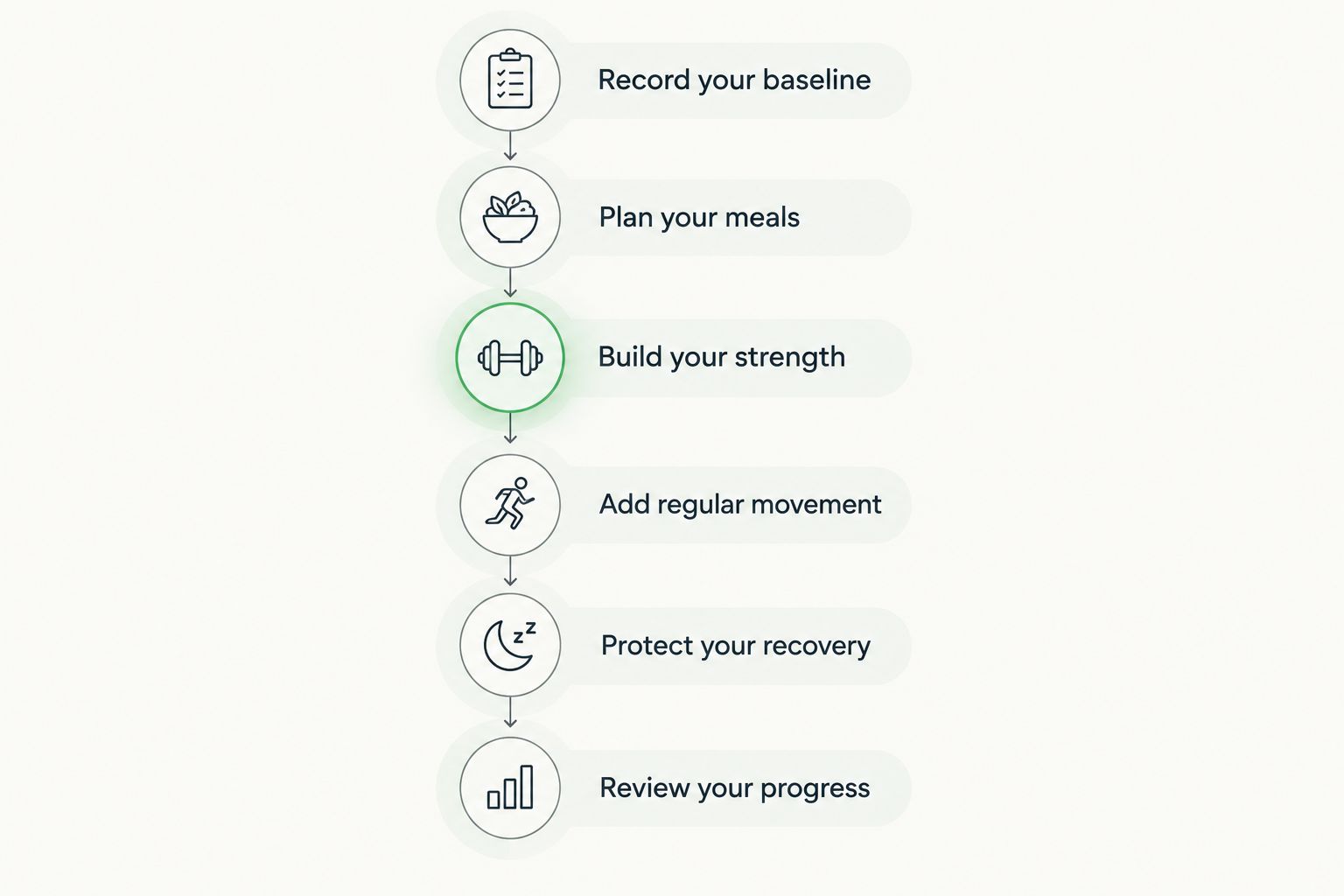
Record your baseline
Start manually with a notebook or spreadsheet. Record your weight under similar conditions, measure your waist consistently, and describe what a normal week of eating and movement actually looks like. Include weekends rather than documenting only your most disciplined days.
Keep the baseline useful, not exhaustive. A written record of meals, drinks, workouts, and sleep gives you something concrete to review when progress changes. You do not need a wearable or a body-composition scan to begin.
Before increasing exercise intensity, discuss known medical conditions, recent surgery, or concerning symptoms with a qualified clinician. Chest pain, fainting, or unusual breathlessness calls for medical assessment—not a harder workout or a trainer's diagnosis.
- Record your baseline weight and waist measurement.
- Note medications and relevant health conditions for your clinician.
- List movements that cause pain or feel unfamiliar.
- Identify realistic workout windows in your calendar.
- Write down your main goal beyond a scale number.
Plan your meals
Use a simple food record first. Identify meals that leave you hungry, drinks you consume without much thought, and situations where convenience overrides your intentions. Weight loss requires an energy deficit over time, but a severe restriction is not a prerequisite.
Build meals around a protein source, vegetables or fruit, and portions of other foods that suit your needs. Protein supports muscle maintenance; it does not cancel out overall food intake. Keep foods you enjoy in the plan instead of creating a long forbidden-food list.
TBT Fitness Studios offers customized meal plans for people seeking weight loss and body transformation. That provides a structured alternative to planning meals alone; confirm how a plan accommodates your preferences and schedule. Medical nutrition needs, including kidney disease or complex diabetes management, belong with an appropriately qualified healthcare professional.
- Record drinks, snacks, and weekend meals.
- Include a protein source in your main meals.
- Prepare a fallback meal for busy evenings.
- Choose portions you can repeat without persistent hunger.
- Ask how meal-plan adjustments are handled.
Build your strength
Start with controlled movements you can perform comfortably. A basic strength plan covers major movement patterns, such as squatting to a chair, pushing, pulling, and hinging at the hips. Exercise selection should reflect your ability and limitations, not an age-based label.
For your 2026 activity plan, the CDC's adult physical activity guidance recommends muscle-strengthening activity involving all major muscle groups on at least 2 days per week. That is a general health recommendation, not an individualized training prescription.
Personal training adds instruction and feedback when exercise technique or progression is unfamiliar. Its limitation is that coached sessions still require your attendance and follow-through. When comparing personal training studios in New Jersey, ask how coaches select exercises, record progress, and adapt sessions when something hurts.
- Select movements you can perform with control.
- Record exercises, resistance, and repetitions.
- Increase difficulty only when technique stays consistent.
- Tell your coach about pain rather than working through it.
- Schedule strength sessions before filling spare time with more cardio.
Add regular movement
Begin with walking or another accessible activity rather than treating every session as a test. Your starting point matters: someone returning after a long break needs a different workload from someone already training consistently.
The CDC's adult activity guidance recommends at least 150 minutes per week of moderate-intensity aerobic activity, alongside muscle strengthening. At moderate intensity, you can generally talk but not sing. One way to distribute that amount is 30 minutes on 5 days; shorter periods also count toward the total.
These are general health targets, not guaranteed weight loss doses. If you are currently inactive, build up gradually instead of forcing the full schedule immediately. A repeatable walking routine is more useful than occasional exhausting workouts followed by inactivity.
- Identify a comfortable walking route.
- Add movement to an existing daily routine.
- Use the talk test to judge moderate effort.
- Increase duration gradually from your current baseline.
- Keep an indoor alternative for disrupted days.
Protect your recovery
Start by giving sleep a consistent place in your schedule. Record bedtime and wake time alongside your training log, especially if late work, travel, or caregiving affects recovery. A plan that repeatedly sacrifices sleep needs revision.
Recovery also means separating challenging training from constant maximal effort. You do not need soreness to prove a workout worked. If fatigue keeps rising, review training volume, food intake, sleep, and symptoms before adding more exercise.
For your 2026 plan, use recovery notes to guide conversations with your coach or clinician. Loud snoring, witnessed breathing pauses during sleep, or persistent daytime sleepiness warrants medical discussion. A fitness program does not diagnose or treat a sleep disorder.
- Keep bedtime and wake time reasonably consistent.
- Note persistent fatigue in your training record.
- Alternate challenging sessions with easier activity as needed.
- Adjust exercises that repeatedly aggravate a joint.
- Discuss ongoing sleep symptoms with a clinician.
Review your progress
Use a simple spreadsheet before adding another app. Compare weight trends, waist measurements, strength, and completed workouts rather than treating a single weigh-in as a verdict. Body weight fluctuates with hydration, food, and other short-term factors.
InBody composition analysis adds estimated body-composition information to that review. TBT Fitness Studios offers this service, but an InBody result is not a direct measurement of fat loss or a medical diagnosis. Hydration and testing conditions can affect bioelectrical impedance estimates.
Review the plan before making the plan harder. If your trend is not moving toward your goal, first check whether the eating and activity plan was followed consistently. Change an identifiable part of the routine rather than cutting food and increasing training simultaneously.
- Compare measurements taken under similar conditions.
- Review completed sessions, not just scheduled sessions.
- Track strength alongside body-weight changes.
- Keep scan preparation consistent when using InBody.
- Record each adjustment so its effect can be reviewed.
Compare weight loss program options for men over 40
The best option addresses your biggest obstacle. Choose individual instruction for exercise uncertainty, shared sessions for group structure, or clinical care when health needs require medical oversight. Different options can work together, but combining them does not remove the need for a manageable schedule.
| Option | Best for | Main advantage | Key limitation |
|---|---|---|---|
| Self-directed eating and exercise plan | Men comfortable planning and tracking independently | Direct control over routines and adjustments | No built-in professional feedback |
| Personal training | Men needing exercise instruction and progression | Individual attention to training execution | Training alone does not organize meals outside sessions |
| Group fitness classes | Men who prefer shared sessions and scheduled workouts | A defined place and time to exercise | Less individual attention than one-to-one training |
| Customized meal planning | Men whose main obstacle is organizing food | A written structure for everyday eating | A meal plan still requires preparation and follow-through |
| Clinician-led weight management | Men with medical concerns or questions about treatment | Medical assessment and treatment decisions | Does not replace everyday eating and activity habits |
For 2026, compare what happens after enrollment, not just what the program includes on paper. Ask who reviews your progress, how adjustments happen, and what to do if an exercise or eating approach does not suit you.
InBody analysis is a measurement option, not a standalone weight loss program. Treat it as supplementary information rather than the reason to choose a provider.
Common mistakes men over 40 make
Restarting at an old training level
Your previous routine is not automatically your current starting point. After time away, establish what you can perform comfortably now and progress from there. Do not use an old lifting record to select your first session's workload.
Treating every plateau as an age problem
A flat scale trend does not establish a hormonal diagnosis. Review measurement consistency, eating habits, activity, and adherence first. Discuss persistent symptoms with a clinician rather than assuming a supplement or hormone treatment is the answer.
Using cardio to compensate for eating
Exercise supports health and weight management, but punishment workouts do not create a practical meal plan. Organize food and activity separately so a missed workout does not trigger extreme restriction—or an excuse to abandon the week.
Choosing a program that ignores the calendar
A demanding schedule is not useful if you cannot attend it. Choose sessions you can reach consistently and define a fallback routine for travel, overtime, or family commitments. Judge the program against your ordinary week.
Treating a scan as a pass-or-fail test
Body-composition estimates can shift with testing conditions. Compare repeated measurements alongside waist changes, strength, and behavior. Do not overhaul your eating plan because one scan differs from your expectations.
FAQ
What's the best weight loss program for men over 40?
The best weight loss program for men over 40 combines manageable eating habits, strength training, regular activity, and progress reviews. Choose the support format that addresses your main obstacle, and involve a clinician when medical conditions or symptoms require it.
Is personal training better than group fitness for losing weight?
Personal training is better suited to individual exercise instruction, while group fitness suits men who prefer shared sessions and a fixed class structure. Neither format guarantees weight loss; eating habits and consistent participation still matter.
How much exercise should a man over 40 do each week?
The CDC's adult guidance recommends at least 150 minutes of moderate-intensity aerobic activity per week and muscle-strengthening activity on at least 2 days. Build toward these general targets from your current ability, with medical guidance when appropriate.
Do men over 40 need a special diet to lose belly fat?
Turning 40 does not automatically require a special diet, and abdominal exercises do not selectively remove belly fat. Use a sustainable eating pattern that supports an energy deficit while keeping strength training in your routine.
Can I start losing weight without joining a gym?
Yes, you can start with planned meals, walking, suitable strength exercises, and a written progress log. Coaching adds instruction and structure when you need help choosing exercises or following a routine.
Is an InBody scan necessary before starting a weight loss program?
No, an InBody scan is optional. Weight trends, waist measurements, and training records provide useful starting information; bioelectrical impedance estimates add context but are affected by hydration and testing conditions.
When should I talk to a doctor before starting?
Talk to a clinician before increasing exercise intensity if you have relevant medical conditions, recent surgery, or concerning symptoms. Chest pain, fainting, or unusual breathlessness requires medical assessment rather than a routine fitness adjustment.
One last thing
Write your fallback plan before your ideal plan. Decide what you will eat when you cannot cook and how you will move when your normal workout falls through. Your 2026 weight loss plan needs a workable version for difficult weeks—not just a perfect version for easy ones.